

What a disability assist dog is
Under the Dog Control Act 1996 (the Act), the term disability assist dog is used. While this is the legal term, ‘service dog’ and ‘assistance dog’ are also commonly used and are understood to mean the same thing.
Disability assist dogs are individually trained to perform tasks that help people with disabilities participate more independently in everyday life. They must be fully certified or in training by an authorised organisation listed under Schedule 5 of the Dog Control Act 1996.
See Schedule 5 of the Dog Control Act 1996 (Legislation website). (opens in new tab)
The authorised Schedule 5 organisations have agreed minimum training and certification standards for their disability assist dogs. For example, the dog:
- has been trained to perform at least three tasks that assist a person with their disability
- has been assessed to ensure it is safe, reliable and well behaved in public
- meets the training and certification standards of its certifying organisation
- works in partnership with its handler to support independence and participation in daily life
- is certified, or in training, through one of New Zealand's authorised certifying organisations.
These dogs are not pets. Emotional support animals, therapy animals, companion animals and off-duty working dogs are not certified service dogs and do not have the same legal access rights, although businesses may choose to admit them.
NB: K9 Search Medical Detection (K9SMD) teams have legal access rights, however they are not part of the authorised Schedule 5 organisations that have established nationally agreed standards and oversight.
Disability assist dog access rights
Disability assist dog teams or teams in training have legal access rights under the Dog Control Act 1996.
See Dog Control Act 1996 (Legislation website).(opens in new tab)
They may enter public places and private businesses that are open to the public, even where general “no dogs” policies apply. This means they are allowed in:
- buses, trains, taxis, and other public transport
- shops, movie theatres, and other retail spaces
- cafés and restaurants
- hotels and accommodation buildings
- hospitals and other health facilities
- public buildings and services (for example reception areas)
- places of assembly, including churches and conference facilities
- education settings.
Any of these places can set reasonable conditions, for example, the dog must stay on the floor and remain under the handler’s control.
Disability assist dogs and dogs in training do not need to wear muzzles.
How to recognise a disability assist dog or a disability assist dog in training
The authorised Schedule 5 organisations currently require their disability assist dogs and dogs in training to:
- be on a lead
- wear an identifying jacket or harness
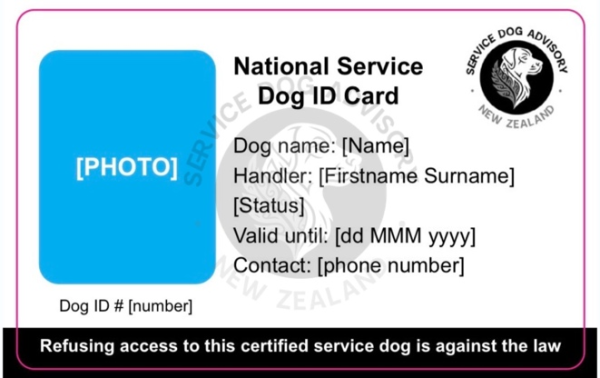
- carry an ID card and/or a National Service Dog ID Card.
While New Zealand legislation uses the term "disability assist dog", the term "service dog" or “assistance dog” is commonly used in practice to describe the same certified dogs. These are not to be confused with companion or support dogs.
National Service Dog ID Card
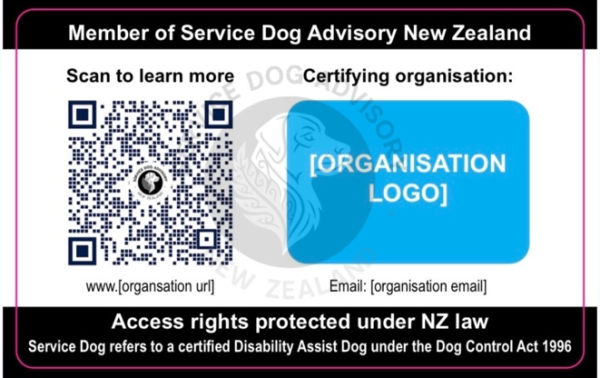
The National Service Dog ID Card is an identification card for disability assist dog teams that is issued and managed by authorised Schedule 5 organisations.
The card can be helpful to assist businesses and service providers to recognise that:
- the dog is either certified or in training under an authorised New Zealand disability assist dog organisation, and meets nationally agreed minimum standards
- the handler has legal access rights.
However, the card alone does not create access rights. The absence of a card does not conclusively say they do not have access rights and should not be used as a reason to deny access. Verification may be sought from the certifying organisations.
The card aims to support the rights, independence and inclusion of people who rely on disability assist dogs and provide a nationally recognised way to identify disability assist dog teams that already have legal access rights under New Zealand legislation.
Each card is issued and managed by the organisation responsible for certifying the team.
If you are unsure, it is okay to politely ask which organisation certified the disability assist dog. Do not ask about the person's disability.
NB: While K9SMD teams have legal access rights, they are not part of the National Service Dog ID Card system and are not certified under the same nationally agreed standards and oversight. They are not eligible to receive the National Service Dog ID Card.
Example of the National Service Dog ID Card:
Front of the ID card
Back of the ID card
What businesses and service providers need to know
Refusing access to a person because they rely on a disability assist dog may constitute unlawful discrimination under the Human Rights Act 1993.
See what is unlawful discrimination (Human Rights Commission website).(opens in new tab)
When a person with a disability assist dog accesses a place or service:
- Allow the team to enter and stay without delay.
- Do not ask about the person's disability.
- Do not separate the handler from their dog.
- Do not charge additional fees because of the dog.
- Treat the person with dignity and respect.
- You may ask which organisation has certified this dog and ask to see their ID.
You may set reasonable conditions, for example, the dog must stay on the floor and remain under the handler’s control.
How to behave around a disability assist dog
A few simple things can make a big difference:
- Welcome the handler and their dog – they are a team.
- Speak to the person, not the dog.
- Give the team space.
- Do not pat, feed, or distract the dog.
- Do not ask about the person’s disability.
What to expect from a disability assist dog
Disability assist dogs:
- behave well in public
- remain calm and under control
- have a safe, reliable temperament
- are clean and do not pose a hygiene risk
- are fully toilet trained.
If you have concerns about the dog's behaviour, contact the organisation that certified the dog. The organisation's name will be on the dog's jacket or harness and on the ID card.
What dog handlers need to know
You can help businesses and service providers recognise your dog by clearly stating it is a disability assist dog, and/or showing your ID card.
If access is refused
If a business refuses access to you and your disability assist dog team, you can make a complaint to Te kāhui Tika Tangata - Human Rights Commission.
See Te Kāhui Tika Tangata Human Rights Commission to make a complaint. (opens in new tab)
They offer a free and confidential dispute resolution service for complaints about unlawful discrimination under the Human Rights Act 1993.
Certifying organisations
These organisations are authorised under the Dog Control Act 1996 to train and certify disability assist dogs:
- Assistance Dogs New Zealand Trust(opens in new tab)
- Hearing Dogs for Deaf People New Zealand(opens in new tab)
- K9 Medical Detection New Zealand(opens in new tab)
- Mobility Assistance Dogs Trust(opens in new tab)
- New Zealand Epilepsy Assist Dogs Trust(opens in new tab)
- Pawsible Service Dogs(opens in new tab)
- Perfect Partners Assistance Dogs Trust(opens in new tab)
- Royal New Zealand Foundation of the Blind Incorporated(opens in new tab).
Each organisation maintains its own training, assessment, certification, and ongoing monitoring processes.
K9 Search Medical Detection
K9 Search Medical Detection (K9SMD) was removed from the list of authorised Schedule 5 organisations on 20 December 2024. Any dogs certified by K9SMD before this date retain their legal access rights. From 20 December 2024, no dogs can be certified by K9SMD.
While K9SMD teams retain legal access rights, they are not part of the National Service Dog ID Card system and are not certified under the same nationally agreed standards and oversight. They are not eligible to receive the National Service Dog ID Card.
Questions about a card or team
Any questions or concerns about a specific card or team should be directed to the issuing organisation listed on the card or the Ministry.
Guidance for health practitioners
This factsheet provides information for health practitioners’ reference when discussing a service dog with their patients.
Factsheet for Health Practitioners (PDF, 297KB)
Guidelines for authorisation to certify disability assist dogs
Guidelines for authorisation to certify disability assist dogs
Contact us
You can contact us at dogs@mcert.govt.nz