

Background
Dog law focuses on improving dog control and increasing public safety around dogs. At the same time, the right and ability of people to enjoy owning dogs is protected.
While no law can stop all dog attacks, the law encourages responsible dog ownership and provides councils with more dog control enforcement powers and tools.
The key dog control tools are registration of all dogs over three months old, microchipping all newly registered and nuisance dogs and the National Dog Database. Together they help councils to enforce owner responsibilities, keep track of problem dogs and enable an owner and their lost or stolen dog to be reunited.
Safety around dogs is a combination of good law, good enforcement, compliance by dog owners and community support.
Registration
The Dog Control Act 1996 requires all dogs over 3 months old to be registered with their local council every year by 1 July. Registration fees are set by councils to take into account the cost of providing dog control services in their area and the balance between dog owners bearing the costs of dog control and the benefits to ratepayers of having safe and well controlled dogs in their community.
Every council must keep a record of all dogs registered. All councils provide information on the dog and its owner along with its microchip number (if it has one) to the National Dog Data Base (NDD).
Microchipping
All dogs registered in New Zealand for the first time (except working farm dogs, which are exempt) are required to be microchipped using an approved microchip, correctly inserted. Microchipping was introduced in July 2006 and provides a simple, lifelong way of identifying dogs and linking them to their owner, making dog control easier and more effective. Microchipping is required for:
- Dogs first registered since July 2006, except farm dogs used for working stock
- Dogs classified as dangerous or menacing, including dogs classified since 1 December 2003
- Unregistered dogs that are impounded
- Registered dogs that are impounded twice.
Frequently asked questions and answers about microchipping
National dog database
The National Dog Database holds information on all registered dogs including registration details, microchip number (if applicable), breed and year of birth. Contact details of owners are also recorded.
Local councils supply and maintain information held on the database. The data base is managed by the Ministry of Cities, Environment, Regions, and Transport. The information on the database is not available to the general public.
Find out more about the National Dog Database
Powers of councils
Councils are required to have a dog control policy. This includes setting registration and other fees and stipulating leash-free exercise areas and areas where dogs must be kept on a leash or where they are prohibited (except for disability assist dogs).
Councils can disqualify someone from owning a dog, or declare them to be a probationary dog owner for certain types of offending specified in the Act, and they can require probationary owners to take part in an approved dog education programme and/or a dog obedience course.
Dog control officers can seize dogs not under direct control of a person or not fenced in (free to leave the property) along with dogs that are straying, unregistered, are aggressive, or not receiving adequate food, water or shelter.
Councils have the authority to issue infringement notices if regulations and local bylaws are broken.
Menacing and dangerous dogs
Councils have powers to declare a dog menacing or dangerous in certain circumstances, including if the dog is considered a threat to any person, animal or protected wildlife.
Menacing dogs include those that a council believes poses a threat to public safety because of their behaviour or the characteristics of the breed. Councils must also classify a dog as menacing if there are reasonable grounds to believe it belongs wholly or predominantly to one or more of the breeds or types of dog that it is illegal to import into New Zealand (under Schedule 4 of the Dog Control Act). Currently these 'banned' breeds are American Pit Bull Terrier, Dogo Argentino, Brazilian Fila, Japanese Tosa and Perro de Presa Canario.
Other breeds or types of dogs can be added to the list of restricted dogs, but only after an Order in Council is agreed by Executive Council and formally signed by the Governor-General.
Menacing dogs must be muzzled when in public and councils may require them to be neutered.
Dangerous dogs include those where an owner is convicted of an offence under 57A of the Dog Control Act, or where, on the basis of sworn evidence, the council believes a dog is a threat to public safety or where the owner records in writing that it is a threat to public safety.
Dangerous dogs must be kept in a fenced part of the owner's property, must be muzzled, on a leash in public and neutered.
Fines
The penalty for owning a dog involved in an attack causing serious injury is up to three years’ imprisonment and/or a fine of up to $20,000. The penalty for not registering a dog is $300 as it the penalty for not microchipping a dog if required to do so.
Owner responsibilities
The law emphasises that owners are responsible for controlling their dogs. This includes using or carrying a leash when taking a dog out in public.
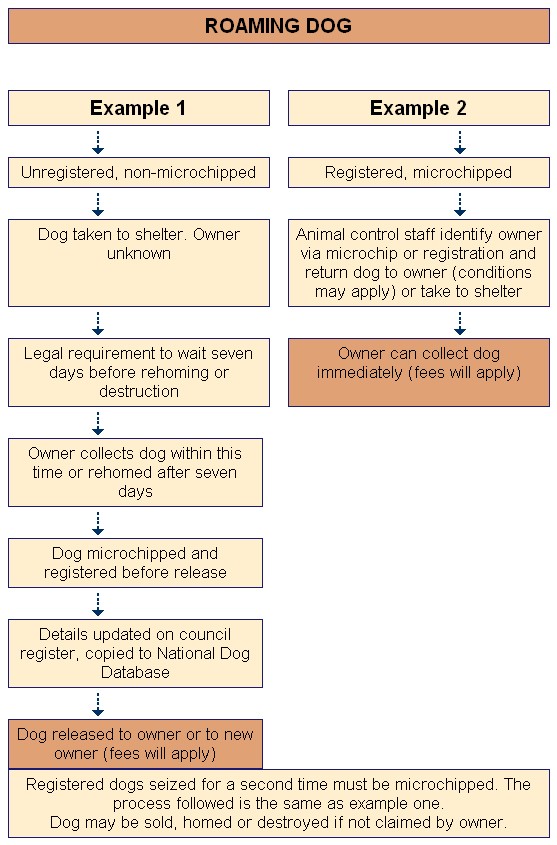
What happens when a dog is impounded?
Councils are responsible for enforcing dog control laws. This diagram shows what typically happens when dogs are impounded for roaming.
Your rights and remedies
Under the Dog Control Act 1996, dog owners must ensure that dogs do not:
- cause a nuisance to any person
- injure, endanger, or cause distress to any person
- injure stock, poultry, domestic animals, or protected wildlife.
In short, neither you, nor your family nor any animals you might have, should be bothered, intimidated, or injured by dogs.
Dog Control Act 1996 (Legislation website)
Your local council is responsible for administering the law and its own by-laws. By-laws may include designating:
- dog exercise areas
- areas where dogs are prohibited
- areas where dogs may be required to be a leash.
You can find out about the by-laws by contacting your local council.
Dogs causing a nuisance
If a dog is causing a nuisance such as barking or roaming, you could contact the dog’s owner, explain what is bothering you, and ask them to stop or reduce the problem. You might find that the owner is very willing to deal with the issue and may well be unaware of it – for example where a dog barks continually while the owner is away at work.
If the owner is unwilling to fix the problem or doesn't know how to, or if you prefer not to approach the owner directly, you should contact your local council.
Dogs behaving dangerously
If you know of a dog behaving dangerously, for example roaming, rushing, barking aggressively or attacking people or other animals, you should contact your council promptly.
Tell them:
- details that will help identify the dog (such as its owner’s address if you know this, its colour, and breed if you recognise what kind of dog it is)
- date, time, place and any other facts of the incident/s
- the owner’s response, if you have contacted the owner.
Follow up your complaint in writing. Include any other information such a copy of a doctor’s certificate if there was an injury, and whether you would be willing to testify in court.
If the dog has bitten someone or rushed at them in a way likely to result in injury or death, council dog control officers can seize the dog. The owner of the dog may be prosecuted.
Additional information